Passivhaus and AECB Carbonlite, Embodied Carbon Study
Our Role:
M&E design, Building Physics, Sustainability
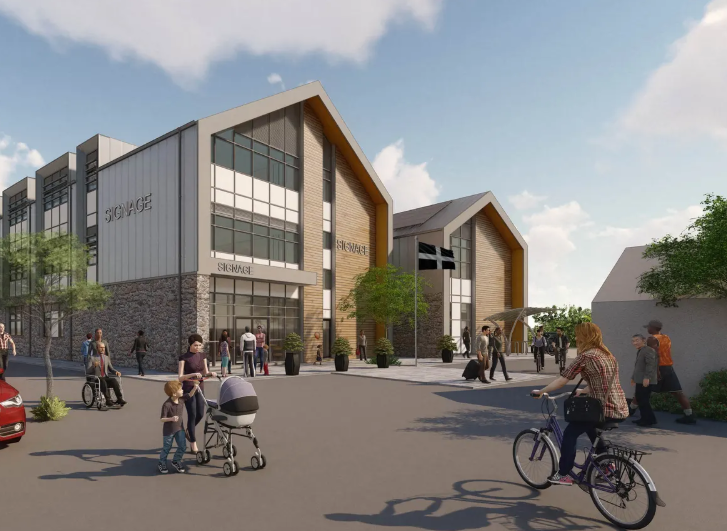
Cornwall Council’s new 1,750m² Integrated Services Hub in Liskeard is a flagship project within the Council’s wider Estates Transformation Programme, bringing together multiple public services into a single, modern and highly sustainable facility.
This landmark development forms part of a wider masterplan for the area, which will also deliver new workspace units and vibrant community spaces, creating a dynamic hub for residents and businesses alike.
Sustainability has been a defining driver of the brief from the outset. The design team was tasked with testing the building against Cornwall Council’s newly developed sustainability guidance, with a clear ambition for a net‑zero‑carbon site and a minimum expectation for net‑zero operational carbon performance within the building’s lifespan
In response, the project adopts a robust fabric‑first approach, drawing on Passivhaus design principles to minimise energy demand before relying on renewables.
The building form and orientation have been carefully modelled to optimise passive solar gain, while fenestration has been designed to balance daylight, heat loss and overheating risk. High levels of insulation, excellent airtightness and reduced thermal bridging significantly lower space‑heating demand, creating a comfortable internal environment with minimal energy input. Detailed computer modelling has been central to the design process, informing both energy performance and summertime thermal comfort strategies.
In line with the council’s ambition to eliminate fossil fuels from its estate, the hub is served by a low‑carbon heating strategy driven by air‑source heat pumps. Mechanical ventilation with heat recovery supports energy efficiency and indoor air quality, while natural ventilation has been incorporated where appropriate to assist passive cooling during warmer periods.
Renewable energy generation is provided through on‑site photovoltaic panels, helping to offset operational energy use, alongside infrastructure to support sustainable travel, including electric vehicle charging and cycle facilities. Embodied carbon has also been a key consideration, with early‑stage analysis informing material selection and structural strategy to reduce whole‑life carbon impacts.